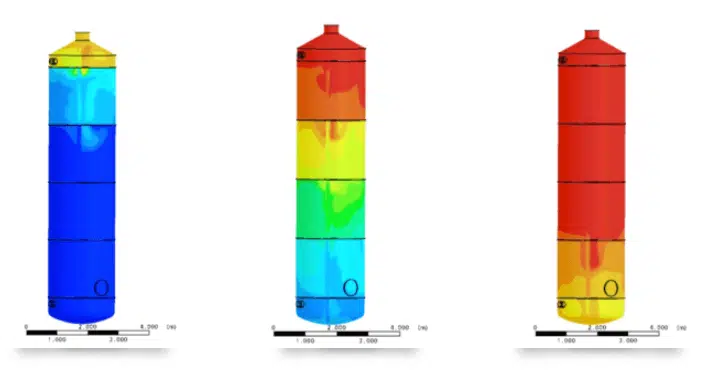
Case study: how the stratification of a storage tank recovers waste heat and boosts a heat pump's efficiency for heating production.
A heat pump recovering the waste heat of a chiller or a process does not necessarily produce when heating is needed. Between the two, a stratified storage tank banks the energy and releases it on demand. EOLIOS optimised this tank by CFD simulation to keep the stratification sharp: it is what decides both the heat actually available and the efficiency (COP) of the heat pump.
The essentials. To valorise heat that would otherwise be lost, EOLIOS paired a heat pump with a storage tank and optimised its stratification with transient CFD. The goal: return genuinely cold water to the heat pump to maximise its COP, deliver hot water at a stable temperature on the use side, and absorb the lag between production and demand. The tank was refined with compartmentalisation and deflectors to use the full working volume.
In the tank, hot water, being less dense, stays at the top; cold water, denser, settles at the bottom. During charging, the heat pump injects hot water at the top while cold water is drawn from the bottom; restitution to the heating reverses these flows. As long as the inlets and outlets cause no mixing, the two zones stay separate and the heat is returned at the right temperature.
The thermocline is the transition layer between the hot water at the top and the cold water at the bottom. Its thickness measures the tank's inefficiency: the thinner and more stable it is, the larger the truly usable volume.
A heat pump's efficiency depends directly on the temperature of the water returning to it. A well-stratified tank returns genuinely cold water drawn from the bottom: the exploited temperature difference grows and the COP rises, the machine produces more heat for the same electricity. Conversely, a poorly stratified tank returns lukewarm water that degrades efficiency and multiplies short compressor cycles. Stratification is therefore a direct lever of energy performance, just like the buoyancy that governs the thermal draught effect.
In heat production, a heat pump is all the more efficient when the temperature lift it must supply is small. By drawing the coolest water from the bottom of a well-stratified tank to reheat it, it works over a reduced gap: each electrical kilowatt-hour produces more heat and the COP rises. Stratification ensures this draw-off at the right level and hot water delivered at a stable temperature; caring for it directly improves energy efficiency, without changing the machine.
The geometry of the tank and its circuit was faithfully reconstructed, then modelled by CFD simulation: the model solves the Navier-Stokes equations coupled with heat transfer to reproduce the tank's real thermal and hydraulic behaviour.
Unlike a steady-state study that describes only a frozen state, the transient analysis tracks the temperature and velocity fields second by second. It reproduces a full charge-and-restitution cycle, where classical calculations reach their limits.
A hybrid mesh of several million elements, refined near the nozzles and at the interfaces between water masses, reveals the weak signals, such as the onset of mixing that would dilute the stored heat.
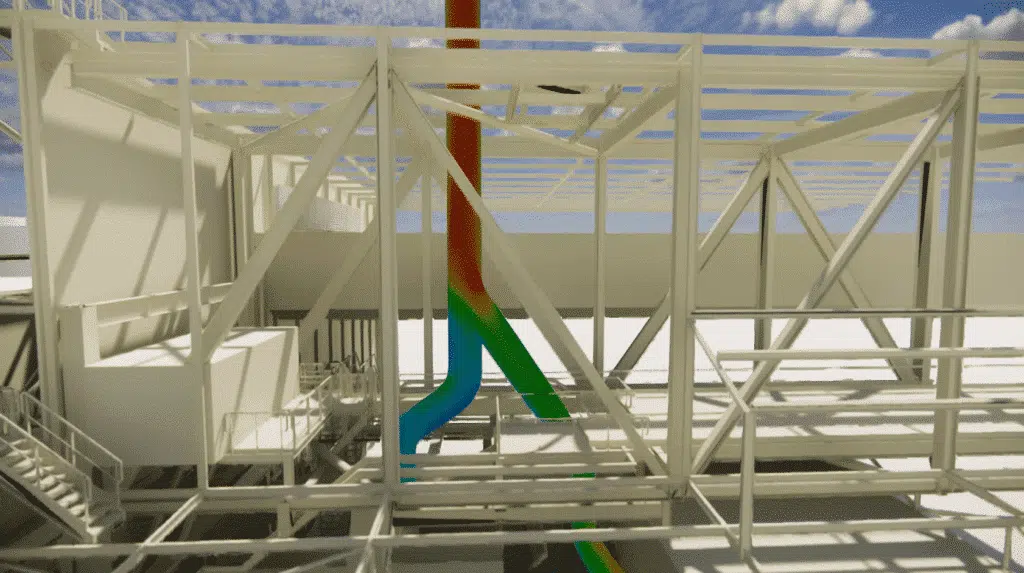
The simulation maps the stratification line and follows its movement across charging and restitution. It highlights the mechanisms that eat into efficiency: an inlet flow that is too brisk and spreads heat over the whole height, short-circuits where the fluid runs from inlet to outlet without mobilising the whole volume, and stagnant dead zones, unused storage capacity.
Tracking the outlet temperature gives the duration for which hot water stays available at temperature before it declines; in parallel, the mean volume temperature reports the tank's state of charge at every moment. These two curves say precisely how much useful energy the tank can return, and at what pace the heat pump must recharge.
Phase-shifting is the time lag between when the heat is produced, while the waste heat is available, and when it is consumed. The tank stores during this lag; well sized, it smooths the peaks and lets the heat pump run at its best efficiency.
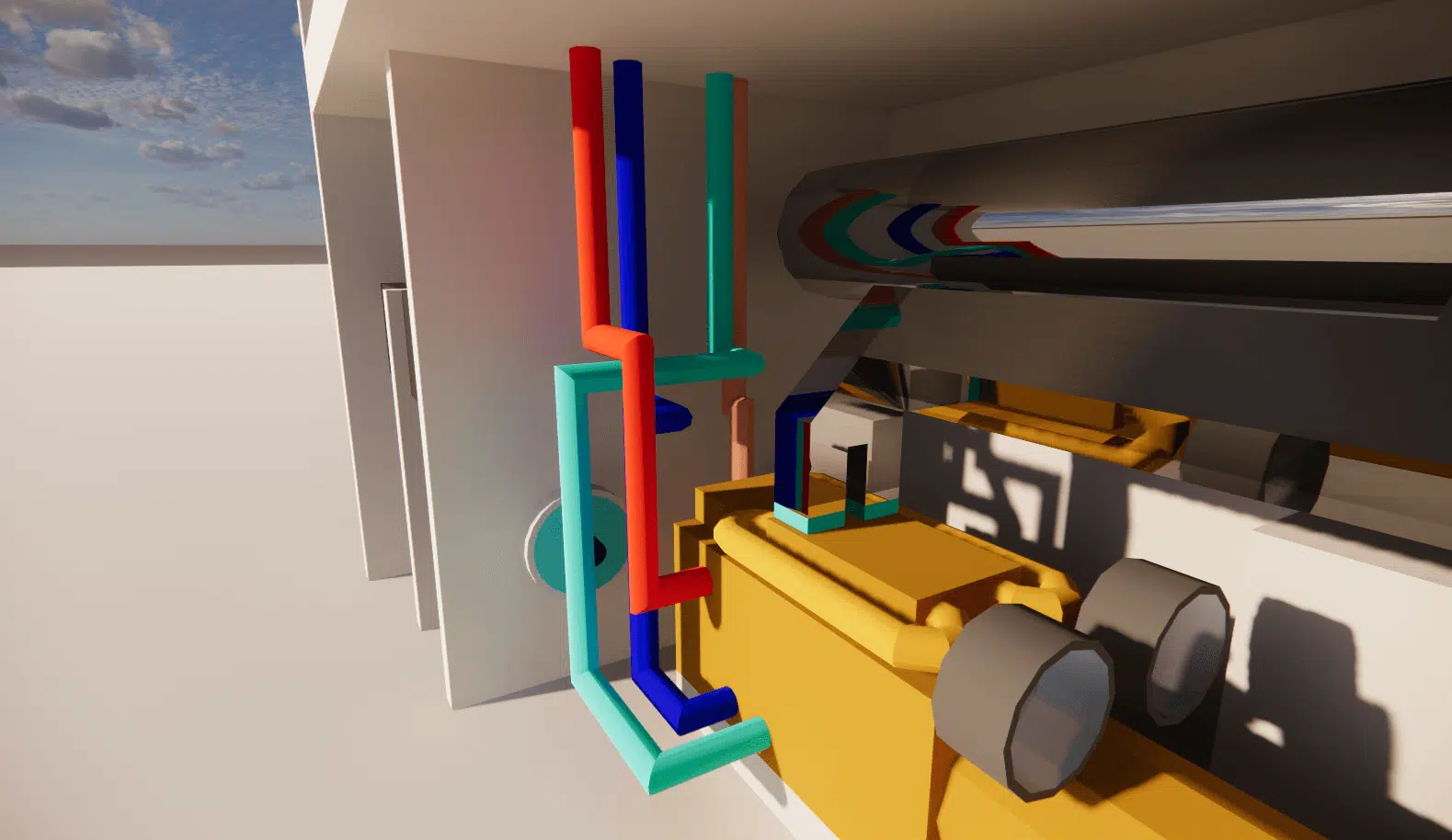
To maximise useful energy without increasing the volume, the study tested several internal-architecture levers:
Horizontal or vertical? A vertical tank offers naturally more stable stratification; a horizontal tank favours lateral convective exchange and loses a little efficiency. This trade-off, quantified by simulation, drives the layout choice and the CAPEX. The delivered model remains a digital twin reusable to test any future scenario.
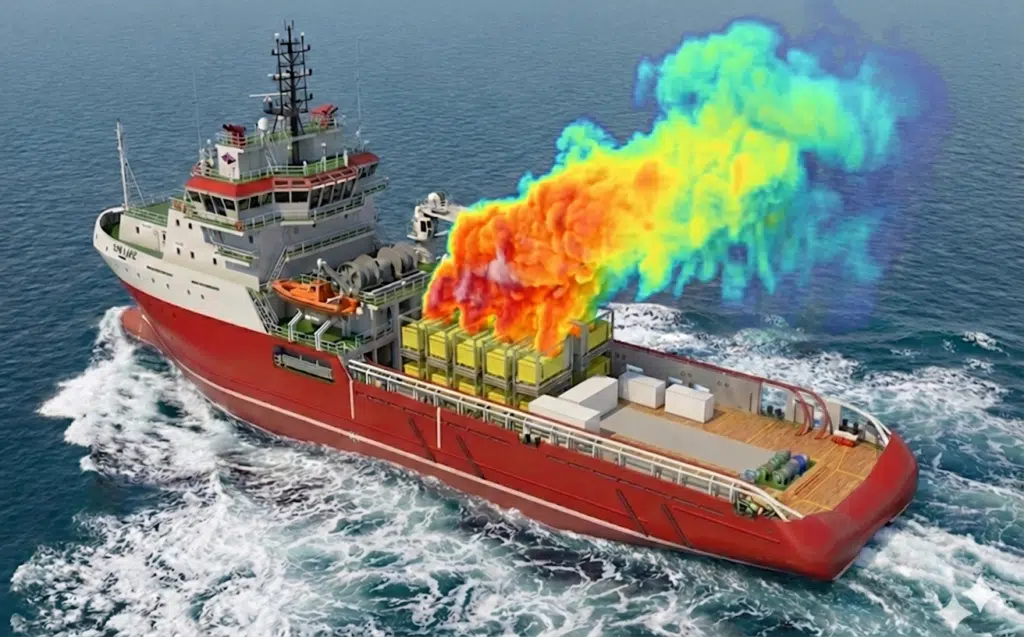
Waste heat is the thermal energy rejected by a process without being its purpose: chiller condensers, compressors, hot effluents, or the servers of a data center. Failing to coincide with the heating need, it is most often lost. Paired with a heat pump and a stratified tank, it is instead captured, stored at its right temperature, then returned for heating or domestic hot water when needed.
This is where storage changes scale: from a simple buffer, it becomes an energy-piloting device. It shaves the peaks, takes advantage of off-peak hours and supplies a heat network or a collective DHW loop without ever mixing the useful temperature levels. HVAC simulation makes it possible to finely tune the tank, the heat pump and the usage profile to maximise the overall efficiency of the installation.
Beyond the immediate saving on the bill, this storage-and-heat-pump pairing is part of a decarbonisation logic: every kilowatt-hour of waste heat fed back into the building or the network is that much fossil primary energy avoided. As regulation pushes to cut the consumption and emissions of the tertiary and industrial stock, a well-stratified tank turns lost heat into a measurable environmental-performance lever, without oversizing the equipment.
This study extends our expertise in water loops and thermal storage: the same stratification physics serves both to secure a cooling supply and to valorise waste heat for heating.
Heat-pump efficiency, thermocline, waste-heat recovery and stratified storage.
Well-stratified water returns genuinely cold water to the heat pump, drawn from the bottom of the tank. The exploited temperature difference grows, the COP rises and the machine produces more heat for the same electricity, as detailed in our HVAC expertise.
It is the heat rejected by a process without being its aim: chillers, compressors, effluents, servers. Storing it in a stratified tank makes it possible to return it for heating or domestic hot water when the need arises, instead of dissipating it.
It is the gap between when the waste heat is available and when it is consumed. The tank absorbs this lag: it banks the energy, smooths the peaks and lets the heat pump run at its best efficiency.
Almost any heat rejected continuously: chiller condensers, compressors, hot effluents, data-center servers, furnaces and industrial processes. As soon as a source is available at a usable temperature, a stratified tank paired with a heat pump can store it and return it later.
Yes: every kilowatt-hour of waste heat fed back replaces that much fossil primary energy. By smoothing peaks and shaving peak demand, stratified storage cuts emissions and the bill, a measurable environmental-performance lever.
Explore our expertise, projects and technical papers to go further than the FAQ.
The thermocline stacks the water by density: it is what decides how much heat is actually available and the efficiency of the heat pump. In transient mode, the simulation follows the thermal front across the charge and restitution cycles, tests the internal-architecture levers from compartmentalisation to deflectors, and shows how well-stratified storage valorises waste heat. Below, the video summary of the study.
CFD expertise, delivered projects and technical dossiers: the whole Industrial process field in one place.
The simplest thing is to talk it through together. Our engineers reply with an initial technical read.