
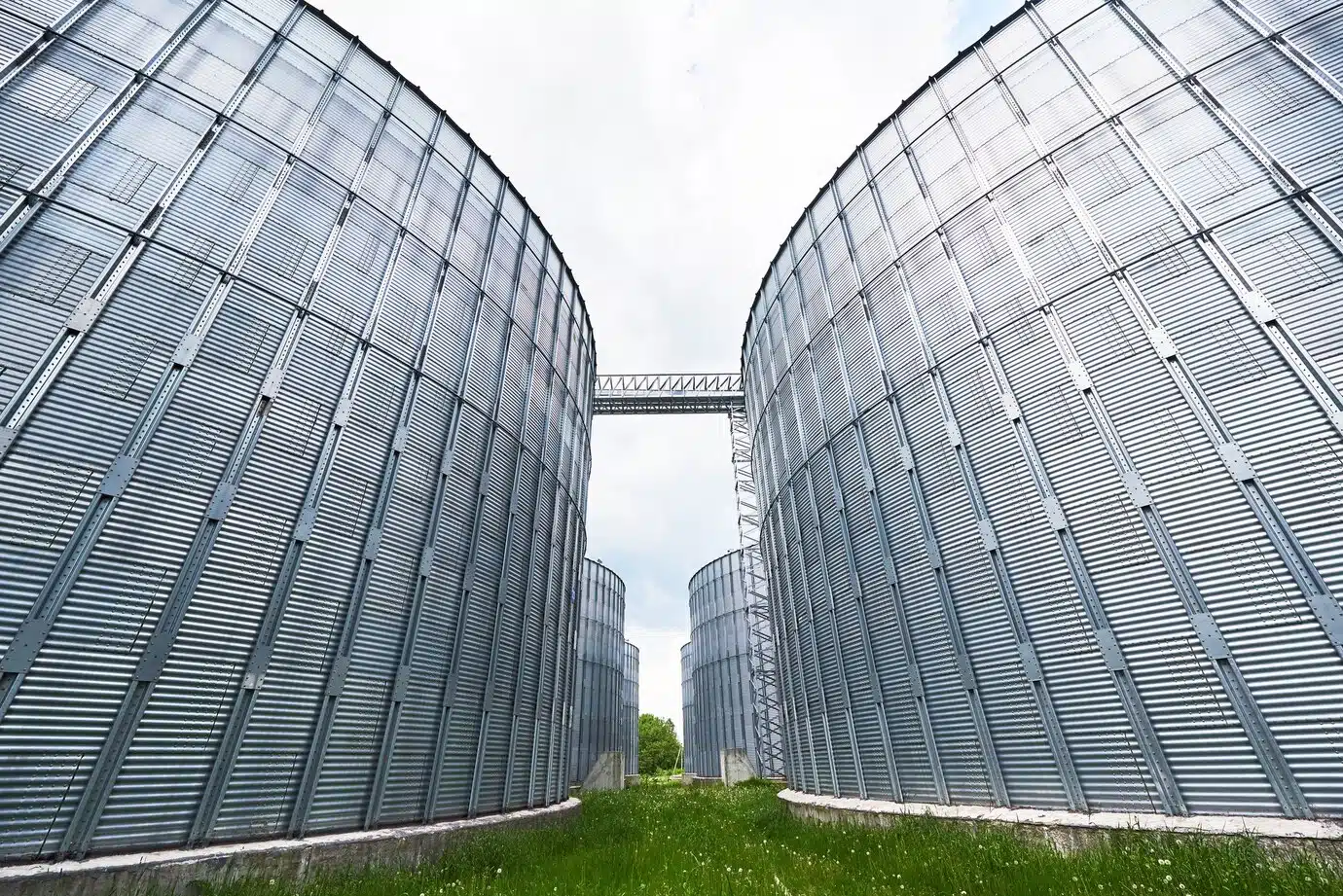
Outdoor liquid storage tank
Expertise · Industrial Process

Tank rupture: wave effect.

EOLIOS improves the safety of outdoor liquid storage: we model through CFD the wave generated by a leak, the overspilled quantity and the spread area to size the retention devices.

Wave effect & overspillRetention basinsReading 5 min
Scroll
Wave effect modelled

Propagation of the wave from a leak and the overspilled liquid quantity predicted.

Spread area

Extent of the contaminated zone visualised to plan the response.

Sized retention

Basins and bund walls calibrated to contain the overspill and protect the environment.

01 — Safety

Securing the outdoor storage of liquids

EOLIOS improves the safety of outdoor liquid storage, a common practice that carries a risk of corrosion and tearing of the tanks.

Model

  • Liquid storage
  • Overspill & wave effect
  • Spread area

Assess

  • Critical failure scenarios
  • Impact study
  • Preventive measures

Design

  • Retention devices
  • Basins & bund walls
  • Tailor-made solutions

Corrosion — caused by the liquid itself or by ambient humidity — can build up over the years and lead to structural failures. Recognised for its expertise in numerical simulation, EOLIOS models the wave generated by a product leak and assists manufacturers in sizing the retention devices, by determining the overspilled liquid quantity and the spread area.
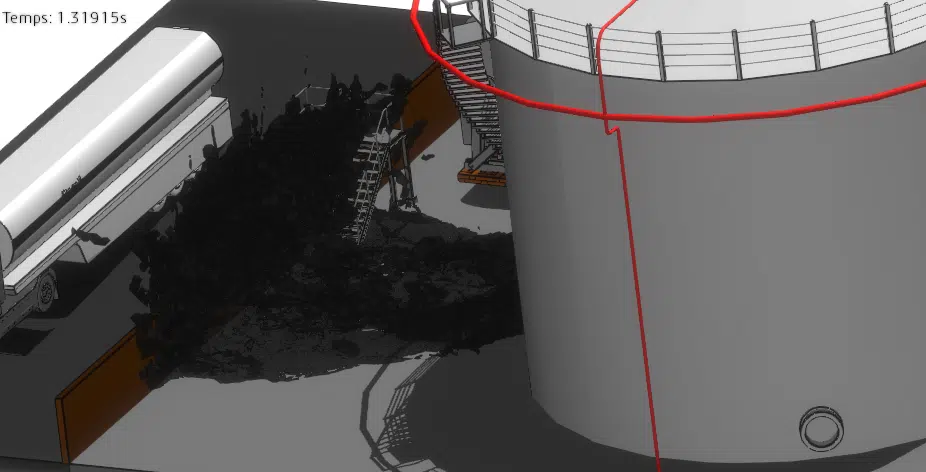
CFD simulation of the wave effect — rupture of a hydrocarbon tank
CFD simulation of the wave effect
02 — Wave effect

Modelling the wave effects of a leak

When a leak occurs, a wave is generated and propagates through the liquid; it can have a significant impact on the retention devices. EOLIOS precisely models its propagation, taking into account the properties of the liquid and the tank. The model determines the overspilled liquid quantity, crucial information for correctly sizing retention basins and bund walls — an excessive overspill leading to environmental pollution and health and safety risks.

CFD modelling of the wave effect

The simulation incorporates several parameters — gravity, liquid density, pressure, tank size, terrain topography and the presence of obstacles — fed into equations solved numerically to obtain a precise representation of the flow.

03 — Spread & retention

Spread area & sizing of the retention systems

Visualising the spread area

Beyond the overspilled quantity, our simulation visualises the extent of the contaminated zone: essential to assess the potential damage and the response measures. This representation helps to identify the at-risk zones and take preventive measures to minimise the consequences of a leak.

Sizing the retention devices

A critical design step: a prolonged overspill causes costly material and environmental damage. By simulating the flow — leak rate, fall height, distance travelled — we precisely determine the quantity of liquid outside the tank, making it possible to size the retention basins optimally.
Stainless-steel storage tank for industrial applications
Liquid storage in a tank
04 — Know-how

Optimising the safety of industrial installations

Proper management of storage risks is essential to prevent accidents and spills, and an appropriate design of the retention devices is the key. From the wave modelling, EOLIOS recommends the ideal spread area by incorporating liquid viscosity, leak rate, tank geometry and environmental constraints.

Each case is unique and requires a tailor-made approach: our fluid-mechanics experts develop bespoke solutions that strengthen the safety of installations, reduce the risk of uncontrolled spillage and minimise the consequences for the environment and the health of workers.

Expertise: water loops & storage tanks

Expertise: air pollution study

FAQ

Frequently asked questions

What industrial companies storing liquids outdoors most often ask us about rupture scenarios.

What is the wave effect in a reservoir rupture?

When a reservoir tears open, the released liquid forms a wave that travels far beyond the footprint of the tank and can overtop a bund sized with a simple volume balance. The simulation reproduces this dynamic by integrating the density of the liquid, the geometry of the reservoir and the topography of the site. The phenomenon also concerns the fuel tanks of generator sets, often located right next to technical rooms.

How does the simulation determine the overtopped volume?

The calculation models the free-surface flow from the breach: leak rate, drop height, wave velocity and interaction with the retention walls. It deduces the volume that passes over the structure during the dynamic phase, information that no static calculation provides. This overtopped volume is the input for sizing the complementary protections.

How are a retention basin or stop logs sized?

The sizing starts from the most unfavourable failure scenario: the clean rupture of the largest reservoir. The simulation provides the overtopped volume and the spill area for the intended retention geometry; the bund height, distance to the tank or position of the stop logs are then adjusted until the event is contained. This approach avoids both under-protection and costly oversizing.

Which parameters influence the propagation of the wave?

The density and viscosity of the liquid determine the energy and spread of the wave; the size of the reservoir and the liquid height set the initial volume and head. The topography of the site, the slopes and the obstacles (buildings, equipment, other tanks) then channel the flow. All these parameters are integrated into the equations solved numerically to represent the real site faithfully.

Why anticipate these scenarios upstream?

Uncontrolled overtopping leads to soil and watercourse pollution, risks for personnel and clean-up costs far higher than the cost of the study. For classified sites, demonstrating containment control is part of the regulatory file. Finally, reservoir corrosion accumulates silently over the years: the rupture scenario must be anticipated before it becomes probable.

Media library · Industrial Process

The process, made visible.

Leaks, flows and heat transfers: CFD anticipates the behaviour of fluids in industrial installations.

The whole media library
Industrial CFD simulationFlows & thermal behaviour
Stockage — stratification
Pressure loss — network
Use cases · Sectors

Where do we model the wave effect?

As soon as a site stores large volumes of liquid outdoors, the rupture of a tank must be anticipated to size the retention. Here are the typical contexts.

Hydrocarbon depots

Storage tanks and retention basins sized for overspill.

Classified site — Hydrocarbons

Chemical & SEVESO sites

Dangerous liquids: containment of the incident and protection of the environment.

Classified site — Chemistry

Tanks & storage vessels

Robust design of the vessels and their safety devices.

Expertise — Thermal storage

Environmental protection

Limiting spills and the pollution of soils and watercourses.

Expertise — Air pollution

Stations & terminals

Fuel tanks and distribution facilities.

Classified site — Terminals

Generator fuel tanks

Day tanks and storage tanks of generator sets.

Expertise — Generator sets
Explore the field

Industrial process: continue exploring.

CFD expertise, delivered projects and technical dossiers: the whole Industrial process field in one place.

CFDExpert engineers
20+Countries
R&DResearch & innovation
Have a project?

The simplest thing is to talk it through together.

A liquid storage to secure, a retention to size, a rupture scenario to anticipate? Our engineers model the wave effect and the spread area through CFD.